



Blogs
Million Chips, Billion Dreams: Building India’s Semiconductor Future | Dr. Sovan Mohanty

Dr Sovan Mohanty
Department of Electronics and Communication Engineering
SRMS College of Engineering and Technology (CET), Bareilly
Introduction
The field of Science and Engineering concerned with the behavior of electrons in devices is called Electronics. Developments in Electronics and Communication Engineering (ECE) have constituted one of the greatest success stories of this century. Electronics is the heartbeat of digital circuits, and semiconductors power every modern device we use today.
The global electronics industry is projected to surpass US$1 trillion by 2030, driven by advancements in Artificial Intelligence (AI), Internet of Things (IoT), and automotive technologies. Furthermore, this growth has the potential to stimulate nearly US$7 trillion worth of economies, enhancing backend applications such as AI and Big Data.
Semiconductors form the foundation for a nation’s competitiveness in the global economy. The semiconductor industry acts as the key engine powering all information technology fields, including personal computing, mobile computing, and cloud computing. However, semiconductor fabrication is among the most complex and sophisticated manufacturing activities undertaken by humanity.
In recent years, rising geopolitical tensions have pushed multinational companies to adopt a “China plus one strategy” to strengthen supply chain resilience, diversification, sustainability, and cost competitiveness across sectors such as biopharmaceuticals, information and communication technology, and green energy.
India’s Semiconductor Journey
India’s semiconductor journey is far more than just chips; it is a revolution aimed at reshaping the future of business, innovation, and global competitiveness. The vision encompasses full-stack production across chip design and fabrication for sectors such as telecom, automotive, consumer electronics, medical devices, and defense electronics.
Semiconductor manufacturing acts as a catalyst for technologies like:
- Internet of Things (IoT)
- Embedded Systems
- Artificial Intelligence
- Robotics
- Satellite Communication
- Aviation Technology
The electronics industry is rapidly advancing into domains such as Quantum Electronics, Superconductor Electronics, Plastic Electronics, Freeform Electronics, and Foldable Electronics, enabling next-generation computation and quantum information processing.
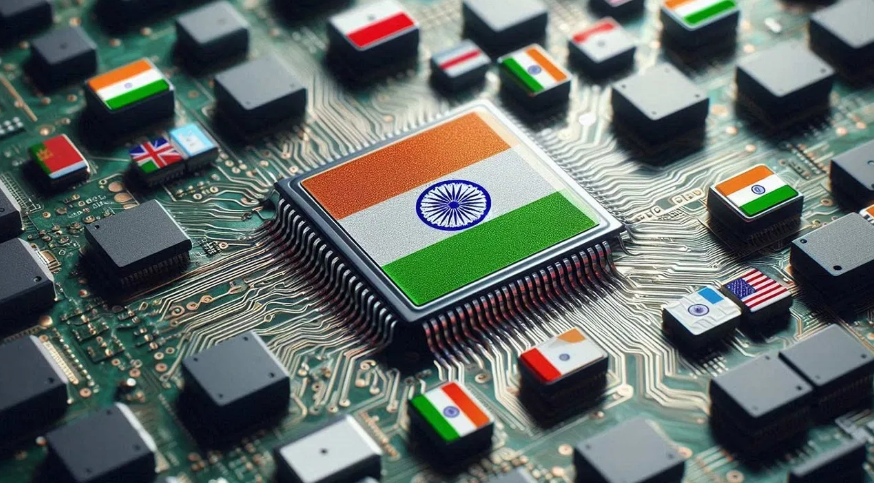
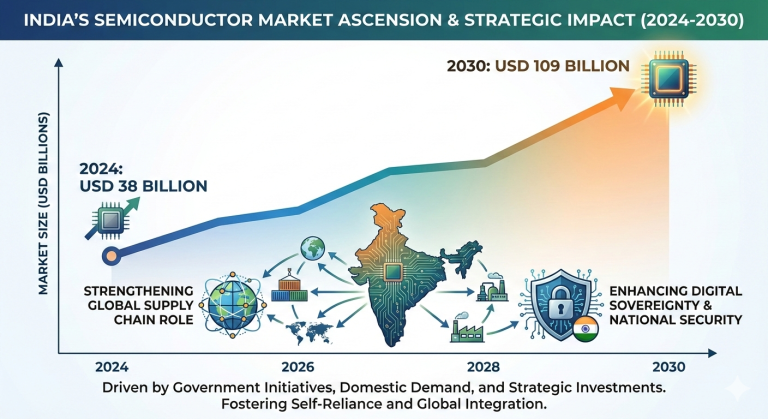
India’s semiconductor market is expected to grow from USD 38 billion in 2024 to USD 109 billion by 2030, strengthening India’s role in the global supply chain while enhancing digital sovereignty and national security.
Why This Is a Breakthrough Era for ECE Graduates in India
With initiatives such as the India Semiconductor Mission and the Make in India for the World campaign, India is firmly focusing on semiconductor designing, manufacturing, assembling, testing, and packaging.
India’s semiconductor push is not merely about producing chips, it represents self-reliance, innovation, and global competitiveness, a space once dominated by the United States, Taiwan, South Korea, and China.
Programmes, Schemes, and Services
The Ministry of Electronics and Information Technology (MeitY) has launched several landmark initiatives to strengthen India’s electronics and semiconductor ecosystem:
- Semicon India Programme
Launched with a massive outlay of ₹76,000 crore, this programme aims to build a robust ecosystem for semiconductor and display manufacturing. - India Semiconductor Mission (ISM)
A dedicated mission under MeitY, Government of India, driving strategic investments, infrastructure development, and talent creation in chip design and fabrication. - Chips to Startup (C2S) Programme
Training 85,000 engineers across 113 institutions in VLSI, embedded systems, and chip design. - Electronic Hardware Schemes
Establishment of Export Oriented Units (EOUs) through incentives and concessions to support electronics hardware manufacturing. - Electronics Component Manufacturing Scheme
Aims to develop a robust component ecosystem by attracting large domestic and global investments and integrating Indian firms into Global Value Chains (GVCs). - Electronic Manufacturing Clusters (EMC) Scheme
Designed to make India a global electronics manufacturing hub by addressing infrastructure challenges. - Production Linked Incentive (PLI) Scheme for IT Hardware
Drives manufacturing of PCBs, displays, camera modules, and strengthens the overall hardware ecosystem. - Modified Special Incentive Package Scheme (M-SIPS)
Attracts investments in Electronics System Design and Manufacturing (ESDM). - Scheme for Promotion of Manufacturing of Electronic Components and Semiconductors (SPECS)
Provides a 25% financial incentive on capital expenditure for electronic components and semiconductor/display manufacturing units.
Major Developments in India’s Semiconductor Ecosystem
India is witnessing a fundamental shift from assembling electronics to designing and manufacturing advanced chips. Key developments include:
- Ten high-value semiconductor projects approved under the India Semiconductor Mission, involving investments worth ₹1.6 trillion, covering legacy node fabrication, advanced packaging, and compound semiconductors.
(Source: Angel One, Nov 28, 2025) - Government incentives across multiple electronics categories to promote domestic chipset innovation and local sourcing.
(Source: Times of India, Sept 10, 2025) - Establishment of new semiconductor facilities, including SiC fabs and advanced OSAT units, across states such as Gujarat, Assam, Odisha, and Punjab.
Semiconductor Talent Shortage
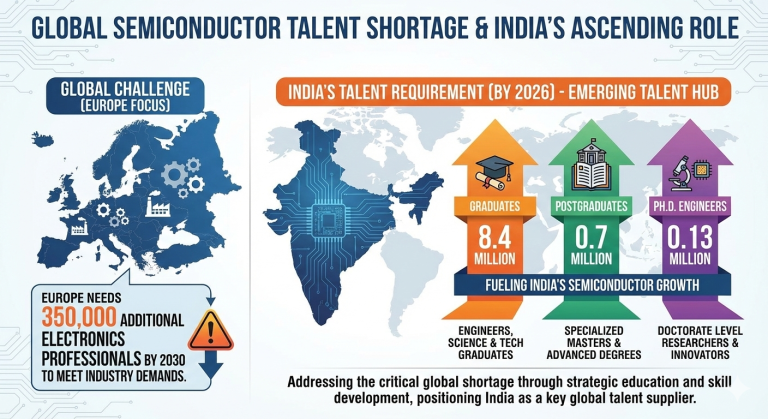
The semiconductor industry is facing a critical global talent shortage. India, as an emerging semiconductor talent hub, will require by 2026:
- 8.4 million graduates
- 0.7 million postgraduates
- 0.13 million Ph.D. engineers
Globally, Europe alone will need 350,000 additional electronics professionals by 2030 to meet current industry demands.
5G and 6G Communication Technology
The telecom sector is a major driver of India’s progress and digital ambitions. Government initiatives are accelerating growth in this sector, leading to:
- Massive Workforce Demand: At least 8 million skilled professionals needed by 2026 to harness 5G’s full potential.
- Up-skilling and Re-skilling Boom: Training programs in cloud computing, cybersecurity, AI/ML, and network engineering to bridge a 28% talent gap.
- 1 Million New Jobs by 2030: Targeting the creation of 10 lakh jobs in the telecom sector.
- Digital Bharat Nidhi Scheme: Expansion of mobile networks in underserved regions, creating jobs in infrastructure and connectivity.
- Inclusive Connectivity Goals: Universal 4G and 90% 5G coverage, driving employment in deployment, device support, and digital literacy.
Role of Electronics and Communication Engineers
Electronics engineers employ computational, theoretical, and experimental tools to design groundbreaking sensors, energy transducers, and advanced computing systems. From VLSI-based architectures with billions of transistors to microcontrollers for radar and communication devices, ECE professionals shape the backbone of modern technology.
They also develop algorithms for disease prediction, solar cell optimization, and autonomous electric vehicles. Electronics and Communication Engineering touches every aspect of modern society.
Focus Areas of Electronics and Communication Engineering
Key focus areas include:
- Integrated Circuits and Systems (VLSI Design)
- 5G and 6G Communication Systems
- Internet of Things (IoT)
- Robotics and Industrial Automation
- Drone Technology
- Nanotechnology
- Optics and Photonics
- Solar Photovoltaics
- Quantum Computing, Communication, and Sensing
- Satellite Communication and Avionics
- Biomedical and Medical Devices (biosensors, bio-imaging, disease modeling)
- Computer Architecture and Networking
- Artificial Intelligence and Machine Learning
- Electronic, Magnetic, Optical, and Quantum Materials
- Signal Processing across entertainment, defense, medical, finance, and communication sectors
Department of Electronics and Communication Engineering at SRMS CET
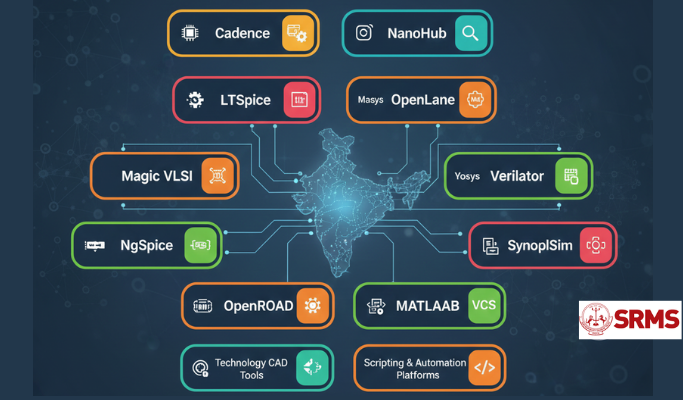
The Department of Electronics and Communication Engineering, Shri Ram Murti Smarak College of Engineering and Technology (CET), Bareilly, offers a premier academic environment fostering innovation and research. The department is continuously upgrading itself to address the national talent gap by incorporating advanced tools such as:
Cadence, NanoHub, LTSpice, Magic VLSI, OpenLane, Yosys, Verilator, NgSpice, OpenROAD, HFSS, MATLAB, ModelSim, Synopsys VCS, Technology CAD tools, scripting, and automation platforms.
Key Highlights
- Centre of Excellence in VLSI Technology
Focused on digital, analog, and mixed-signal chip design, MEMS, and FET-based bio/gas/photo sensors. - Advanced Research Laboratory for EMI/EMC
Dedicated to measuring conducted emissions and electromagnetic compatibility. - Internet of Things Laboratory
Equipped with Arduino, ESP32, Raspberry Pi 5, and other advanced processors for real-world IoT applications. - Antenna Design Facilities
Supporting innovative antenna development and testing. - Drone Technology Facility
Featuring Pixhawk controllers, sensors, IMUs, GPS modules, ground control stations, and more. - Robotrax Club
Hands-on workshops on robotic arms, line-following robots, obstacle-avoiding robots, and Raspberry Pi-based systems. - Higher Education Support
Dedicated time and guidance for GATE, GRE, IELTS, TOEFL, CAT, and GMAT preparation. - Value Addition Courses
Training in ANSYS HFSS, MATLAB, Cadence, LabVIEW, ADS, C, C++, Python, and more.
Conclusion
India is rapidly emerging as a global powerhouse in electronics manufacturing, driven by strong policies, robust investments, and a growing talent pool. With the government’s aggressive push toward semiconductor self-reliance, microprocessor innovation, and advanced manufacturing, Electronics and Communication Engineering is evolving into a core technology frontier.
ECE is advancing into cutting-edge domains such as 2nm chip fabrication, Extreme Ultraviolet Lithography, chiplets, 6G, millimeter-wave, and terahertz communication technologies, continually pushing the boundaries of performance and miniaturization.
As Hon’ble Prime Minister Shri Narendra Modi states:
“The world trusts India, the world believes in India, and the world is ready to build the semiconductor future with India. India is creating a complete ecosystem for designing, manufacturing, packaging, and high-tech devices. Everything will be available right here in India.”